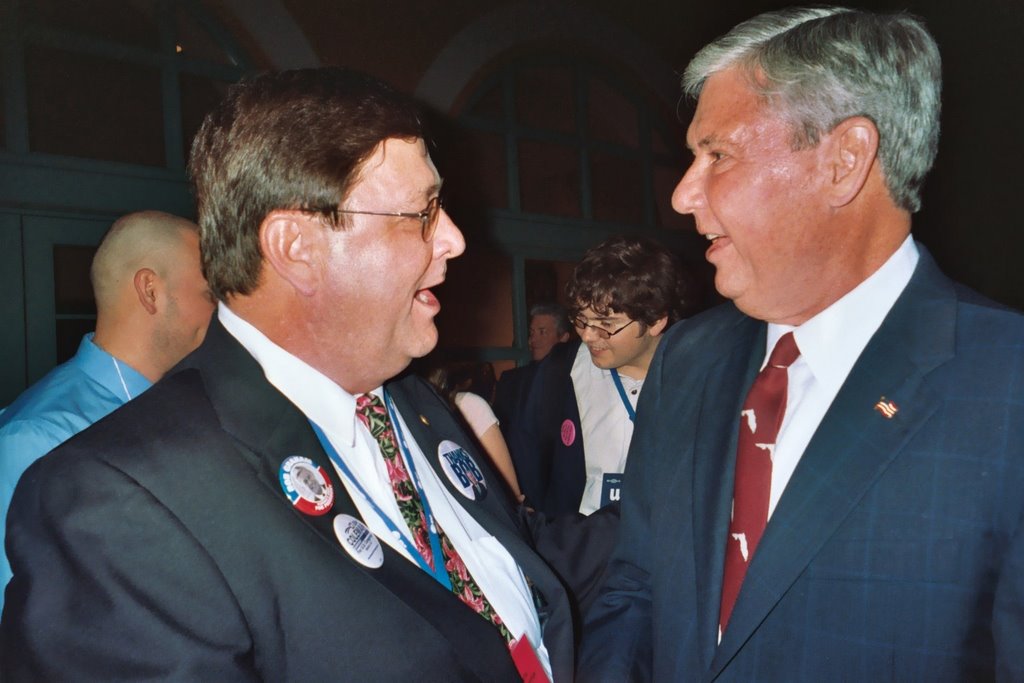
The entire underlying premise of the so called "Christian" Right is based on a lie. If you want to be kinder, you may call it a myth. I do not. It is an outright lie, and should be exposed as such.
Otherwise tolerant Christians were fed the big lie that their religion was under attack from the bogey man secular left. You know, those, nasty, rotten, elitist Liberals. This was the glue that has held the Christian Right together. It is the circle the wagons mentality, the "us" against "them" reflex. Nothing could be further from the truth.
The fact of the matter is the the United States is the most religious, and most religiously tolerant country on the planet. Exit polls from the 2006 election showed 83% of voters self identifying as members of Judeo - Christian religions. Another 6% identified as belonging to an "other" religion. Only 11% identified themselves as having no religion. Is the vast majority of Americans frightened about being under attack from that 11%. That's ludicrous on its face.
Nevertheless, this has been the basic underpinning of the Christian Right movement. What is under attack in this country is the separation of church and state. This is the very provision for religious freedom in the Constitution, the one that has allowed this country to be the most religious and religiously tolerant country in the history of the world. Those who would breach this wall should be very careful what they wish for. This provision was placed in the Constitution at the insistence of those who knew the sufferings of religious intolerance. Those who profess to believe in the wisdom of the Founders should ponder that.
Sunday, May 20, 2007


Thursday, May 17, 2007
Conservative Worldview Breeds Incompetence
Over at Rockridge Nation, they have up a particularly important post on the framing of the incompetence of the Bush administration. Every Republican on the planet is now backing away from Bush and declaring him not a true conservative. This is their explanation for his failures and incompetence in governing.
We need not concede that point. In fact, we can take that frame completely away from them. Follow me below the jump to see how we can do this.
Blog Florida Blue
Cross Posted from Florida Kossacks
From the Rockridge post:
In a piece behind the firewall in today's New York Times, David Greenberg, a professor at Rutgers University, had this to say:
There is a basic reason for this. The conservative worldview is ill equipped to govern and therefore naturally breeds incompetence in governance. The view that government is bad ill prepares conservatives to actually run the government.
Even in their supposed strength in national defense, their management of the armed services and the conflicts in Iraq and Afghanistan has proved disastrous. The Secretary of Defense's famous statement about going to war with the army you have rather than the army you wish you had is a case in point. These conservatives started a war of choice with a military, that by the Secretary's own words, was not the military he needed to do the job.
Other areas of governance have proved even more grossly incompetent. Their inept reaction to Hurricane Katrina is but one example of this. Having political hacks change the reports of scientists and threatening scientists over global warming is another. Management of the environment by people who truly don't believe in the efficacy of environmental management is a proven method of insuring incompetence.
This appears to me to be an area where we could all do a better job in framing our message. It may be true that the current occupant at 1600 Pennsylvania Avenue is particularly incompetent. However, this is by no means an aberration of conservative governance. We should not let the Republicans get away with framing this mess as if it were.
We need not concede that point. In fact, we can take that frame completely away from them. Follow me below the jump to see how we can do this.
Blog Florida Blue
Cross Posted from Florida Kossacks
From the Rockridge post:
What many conservatives are doing today is playing the "blame game," or the "bad apple" defense. It's all Bush's fault, these failures, not ours. We are different, better, competent. The Rockridge Institute pointed out in a piece last year,"Bush is Not Incompetent," that Bush wasn't a failure at all; in fact, by conservatives' standards, he is quite the success. He has achieved many of their goals; that these ended in apparent failure points not to incompetence, or a deviation off the golden conservative path, but to the failure of the conservative vision at its heart.
In a piece behind the firewall in today's New York Times, David Greenberg, a professor at Rutgers University, had this to say:
...if any president has tried to implement conservative ideals, it’s Bush... The result — in the assessment of not just liberals but also other observers — has been disaster: a mess of a war, the failure to plan for Hurricane Katrina, the erosion of the church-state wall, widening inequality, the loss of civil liberties including habeas corpus, and scores of other ills that readers of this column can list as easily as I. This was the fruit of modern American conservatism.
There is a basic reason for this. The conservative worldview is ill equipped to govern and therefore naturally breeds incompetence in governance. The view that government is bad ill prepares conservatives to actually run the government.
Even in their supposed strength in national defense, their management of the armed services and the conflicts in Iraq and Afghanistan has proved disastrous. The Secretary of Defense's famous statement about going to war with the army you have rather than the army you wish you had is a case in point. These conservatives started a war of choice with a military, that by the Secretary's own words, was not the military he needed to do the job.
Other areas of governance have proved even more grossly incompetent. Their inept reaction to Hurricane Katrina is but one example of this. Having political hacks change the reports of scientists and threatening scientists over global warming is another. Management of the environment by people who truly don't believe in the efficacy of environmental management is a proven method of insuring incompetence.
This appears to me to be an area where we could all do a better job in framing our message. It may be true that the current occupant at 1600 Pennsylvania Avenue is particularly incompetent. However, this is by no means an aberration of conservative governance. We should not let the Republicans get away with framing this mess as if it were.
Sunday, May 6, 2007
Bush's New Measure of Success in Iraq: A Timetable for Terrorists
In his post Iraq funding bill veto politicking (yes, Bush is playing politics with the troops), George Bush has come up with yet another measure for success in Iraq. There is something very remarkable about this measurement. It's one that has an extremely ironic twist.
How ironic? Follow me below the fold.
Cross Posted from Florida Kossacks
In November 2005, George Bush defined victory in Iraq this way:
In a speech delivered on May 24, 2004, at the U.S. Army War College, in Carlisle, PA, Bush outlined the steps for success in Iraq:
Now on May 2, 2007, in a speech to the Associated General Contractors of America, George Bush unveiled his latest definition for success in Iraq:
I heard Bush go on to say that sectarian violence staying down for some period of time would be his measure of success. That sounds very much like a timetable to me. Listen to what Bush had to say about timetables in the same speech:
Imagine what George Bush just said to the sectarian militias and insurgents. All you have to do is lay low for a while and we'll declare success and go home. Sounds pretty much like a timetable to me. Why is that any different than the type of timetable that was in the bill he just vetoed? As a matter of fact, the benchmarks in the vetoed bill were a lot more substantial than
Isn't George Bush afraid that after these bad guys lay low and sectarian violence goes down, that these bad guys will then not just follow us home?
How ironic? Follow me below the fold.
Cross Posted from Florida Kossacks
In November 2005, George Bush defined victory in Iraq this way:
Victory in Iraq is Defined in Stages
Short term, Iraq is making steady progress in fighting terrorists, meeting political milestones, building democratic institutions, and standing up security forces.
Medium term, Iraq is in the lead defeating terrorists and providing its own security, with a fully constitutional government in place, and on its way to achieving its economic potential.
Longer term, Iraq is peaceful, united, stable, and secure, well integrated into the international community, and a full partner in the global war on terrorism.
In a speech delivered on May 24, 2004, at the U.S. Army War College, in Carlisle, PA, Bush outlined the steps for success in Iraq:
There are five steps in our plan to help Iraq achieve democracy and freedom. We will hand over authority to a sovereign Iraqi government, help establish security, continue rebuilding Iraq's infrastructure, encourage more international support, and move toward a national election that will bring forward new leaders empowered by the Iraqi people.
Now on May 2, 2007, in a speech to the Associated General Contractors of America, George Bush unveiled his latest definition for success in Iraq:
the definition of success as I described is sectarian violence down. Success is not, no violence. There are parts of our own country that have got a certain
level of violence to it. But success is a level of violence where the people
feel comfortable about living their daily lives.
I heard Bush go on to say that sectarian violence staying down for some period of time would be his measure of success. That sounds very much like a timetable to me. Listen to what Bush had to say about timetables in the same speech:
imagine what a thinking enemy is doing when they hear timetables. Oh, you've got to be out by a certain date? Well, why don't we just wait.
Imagine what George Bush just said to the sectarian militias and insurgents. All you have to do is lay low for a while and we'll declare success and go home. Sounds pretty much like a timetable to me. Why is that any different than the type of timetable that was in the bill he just vetoed? As a matter of fact, the benchmarks in the vetoed bill were a lot more substantial than
sectarian violence down
Isn't George Bush afraid that after these bad guys lay low and sectarian violence goes down, that these bad guys will then not just follow us home?
Monday, April 30, 2007
Candidate Review Wednesday: Overview
This time 4 years ago, I was firmly committed to Florida's favorite son, my former boss, Senator and former Florida Governor Bob Graham. I had taken a look at Howard Dean and liked what I saw. I was not enamored of John Kerry (more on that later) and I thought John Edwards suffered from premature ejaculation (er, uh, candidacy).
This cycle, I am much more conflicted. There is not one candidate who stands head and shoulders above everyone else, in my opinion. Maybe the best candidate isn't even in the race. Maybe the best candidate is ineligible to run again. There are at least two candidates who I would be equally happy to have as my party's nominee. This is the embarrassment of riches we seem to be suffering this year.
Today, I am launching a series of diaries to try and get the fencepost out of my ass. This series is going to be a little bit like examining my navel, something I have successfully avoided doing to this point in my life for the most part. I hope at the end of the day to have developed a coherent reason to support one candidate over all the others.
There are a couple of caveats I should make here. I am going to support the Democratic nominee. Period.
I want to become a paid employee of, or consultant to, the campaign I end up choosing to support. I could repeat my pattern from the last presidential cycle and spend my energy on the Congressional level. That happened after my first choice, Bob Graham, decided he couldn't sustain a viable campaign. This cycle though, I hope I wind up catching on with the ultimate nominee.
There are two top level criteria I am going to use to evaluate the candidates. The first is their ability to win the nomination. The second is their ability to win the general election. You can't have one without the other. That's what happened to Howard Dean in Iowa last cycle. Iowans came to the conclusion that Dean could not win the general. They also came to the mistaken conclusion that John Kerry could, so what do they know?
This cycle, I am much more conflicted. There is not one candidate who stands head and shoulders above everyone else, in my opinion. Maybe the best candidate isn't even in the race. Maybe the best candidate is ineligible to run again. There are at least two candidates who I would be equally happy to have as my party's nominee. This is the embarrassment of riches we seem to be suffering this year.
Today, I am launching a series of diaries to try and get the fencepost out of my ass. This series is going to be a little bit like examining my navel, something I have successfully avoided doing to this point in my life for the most part. I hope at the end of the day to have developed a coherent reason to support one candidate over all the others.
There are a couple of caveats I should make here. I am going to support the Democratic nominee. Period.
I want to become a paid employee of, or consultant to, the campaign I end up choosing to support. I could repeat my pattern from the last presidential cycle and spend my energy on the Congressional level. That happened after my first choice, Bob Graham, decided he couldn't sustain a viable campaign. This cycle though, I hope I wind up catching on with the ultimate nominee.
There are two top level criteria I am going to use to evaluate the candidates. The first is their ability to win the nomination. The second is their ability to win the general election. You can't have one without the other. That's what happened to Howard Dean in Iowa last cycle. Iowans came to the conclusion that Dean could not win the general. They also came to the mistaken conclusion that John Kerry could, so what do they know?
In my attempts to evaluate candidates chances to win the nomination, I am going to look at these factors:
- Values projected in the Message
- Stance on issues
- Fundraising ability
- Staff competence
- Primary strategy
- Does this candidate make me feel it?
I am going to go back to square one and do my own research on all these factors. I am a devotee of values based decision making, so I am going to start with that navel gazing thing. I am going to have to come up with a set of criteria to evaluate how each candidate's message resonates with my values (That's the first and the last criteria on the list above.) Those criteria are, by their nature, subjective. The other criteria are more objective in nature. At the end of the day, it is going to come down to my gut feeling as to which candidate makes me feel it more.
That's how I intend to proceed. It should be an interesting journey.
Thursday, April 26, 2007
Iraq Withdrawal - Post Veto Frame
Our Fearless Leader, Georgie W, today reiterated his plan to veto the Iraq Supplemental Appropriations bill passed by Congress this week. You know, the one with the goal of removing US troops from Iraq by the end of March 2008. What's to worry, you say. The American people are on our side on this.
Well, maybe. They are on our side, if we don't stick our foot in our mouth. Or let the other side frame the debate. Is this a slam dunk? Hardly.
Follow me and you'll get my take on how to play the next inning.
We have got to come out of the gate saying:
The numbers seem to be on our side. 71% of Americans disapprove of Bush's handling of Iraq. 64% believe we should set a timetable for withdrawal. 57% believe Congress should have the final say on Iraq troop levels. Sounds pretty good, huh? Well, not so fast, Skippy. Take a look at this:
56% say Congress should allow the funding after the veto.
That is why we must drive home this point:
Congress gave him the money he asked for, along with reasonable conditions for its use. Bush did not want to be bound by those conditions, so he refused the money. We must not allow the debate to be framed as Congress withholding the money. Congress voted for the money. George Bush refused the money. He is putting our troops lives at risk by refusing the money and refusing to plan a safe redeployment of our troops.
Just say yes, Georgie.
Well, maybe. They are on our side, if we don't stick our foot in our mouth. Or let the other side frame the debate. Is this a slam dunk? Hardly.
Follow me and you'll get my take on how to play the next inning.
We have got to come out of the gate saying:
The President just refused the money needed to get our troops home safely from Iraq. He is now playing politics with the troops lives by refusing to take this money and refusing to plan a safe redeployment.
The numbers seem to be on our side. 71% of Americans disapprove of Bush's handling of Iraq. 64% believe we should set a timetable for withdrawal. 57% believe Congress should have the final say on Iraq troop levels. Sounds pretty good, huh? Well, not so fast, Skippy. Take a look at this:
"The Democrats in Congress have proposed to fund the Iraq war only if the U.S. sets a timetable for troop withdrawal, too. George W. Bush has stated he will veto that proposal. If George W. Bush does veto it, what should the Democrats in Congress do next: should they try to withhold funding for the war until George W. Bush accepts a timetable for troop withdrawal, or should they allow funding for the war, even if there is no timetable?"
56% say Congress should allow the funding after the veto.
That is why we must drive home this point:
Bush refused the money.
Congress gave him the money he asked for, along with reasonable conditions for its use. Bush did not want to be bound by those conditions, so he refused the money. We must not allow the debate to be framed as Congress withholding the money. Congress voted for the money. George Bush refused the money. He is putting our troops lives at risk by refusing the money and refusing to plan a safe redeployment of our troops.
Just say yes, Georgie.
Friday, March 9, 2007
The Big Lie - Iraq - Again - Part II
So many lies, so little time. I was going to write next about the lie that all these horrible consequences would necessarily follow a withdrawal of US troops from combat duty in the Iraq Civil War. I still intend to deal with this topic. However, a new Big Lie has emerged from the Iraq War Supporters.
I am sure you've have heard it. Any mention of placing conditions , or restrictions on the supplemental funding for the war brings forth immediate cries of "micromanagement" from the Iraq War Supporters. Is this really true, or is it just one more Big Lie?
Come below the fold where we'll deconstruct this one and perhaps find some Truth....
Let's start off by defining micromanagement. Dictionary.com gives us this:
House Republican Leader John Boehner had this to say about a recent plan by John Murtha to place restrictions on the use of funds in the upcoming Iraq supplemental funding bill:
Article I, Section 8 of the Constitution:
So it would appear that Congress does indeed have the power to govern the military. In fact, Congress has done just that from the inception of the republic. There is 5 USC CHAPTER 99 - DEPARTMENT OF DEFENSE NATIONAL SECURITY PERSONNEL System passed in January 2005 (For those of you not paying attention, this was in the Republican controlled Congress). Then there is 10 USC TITLE 10 - ARMED FORCES. This entire title of the code is devoted to the governance of the armed forces of the United States. It covers everything from the Joint Chiefs of Staff to Junior Reserve Officer Training Corps.
So Congress has indeed exercised its powers under the Constitution
So, when you hear your Republican friends talking about Congress micromanaging the Iraq war, just point them to Article I, Section 8 of the Constitution. If that doesn't work, direct their attention to 10 USC TITLE 10 - ARMED FORCES. If none of that works, you know you've got the type of Republican who voted for Allan Keyes for the Illinois Senate seat now held by Barak Obama.
I am sure you've have heard it. Any mention of placing conditions , or restrictions on the supplemental funding for the war brings forth immediate cries of "micromanagement" from the Iraq War Supporters. Is this really true, or is it just one more Big Lie?
Come below the fold where we'll deconstruct this one and perhaps find some Truth....
Let's start off by defining micromanagement. Dictionary.com gives us this:
mi·cro·man·age : –verb (used with object), -aged, -ag·ing.
to manage or control with excessive attention to minor details.
[Origin: 1985–90]
—Related forms
mi·cro·man·age·ment, noun
Dictionary.com Unabridged (v
1.1)Based on the Random House Unabridged Dictionary, © Random House, Inc. 2006.
House Republican Leader John Boehner had this to say about a recent plan by John Murtha to place restrictions on the use of funds in the upcoming Iraq supplemental funding bill:
Not to be outdone, Condoleezza Rice said:“His aim, he made clear, is not to improve readiness but to ‘stop the
surge.’ So why not straightforwardly strip the money out of the appropriations
bill -- an action Congress is clearly empowered to take -- rather than try to
micromanage the Army in a way that may be unconstitutional? Because, Mr. Murtha said, it will deflect accusations that he is trying to do what he is trying to
do.”
proposals being drafted by Senate Democrats to limit the war amounted to "the worst of micromanagement of military affairs."Even Australian Broadcasting Corporation's Lateline program is getting in on the act. They quote :
Australian Broadcasting Corporation's Lateline, in the same story, also had this:ROY BLUNT, REPUBLICAN CONGRESSMAN: It's hard to imagine a group less capable of making tactical decisions about specific troop deployments than 535 members of Congress.
NANCY PELOSI, DEMOCRAT HOUSE SPEAKER: No more blank cheques for President Bush on Iraq. Our taxpayer dollars must go to protect our troops, to keep our promises to our veterans and to provide for the safety of the American people. In light of the facts, President Bush's escalation proposal will not make America safer.and this:
TOM LANTOS, DEMOCRAT CONGRESSMAN: We are not fighting terrorism in Iraq. We are attempting to referee a religiously based civil war, which saps our strength and destroys our fabric as a society.So what is all this talk really about? Does Congress in fact have the power to set policies that control how the military operates? Has it been done before?
Article I, Section 8 of the Constitution:
The Congress shall have Power to ...provide for the common Defence and general Welfare of the United States...
To make Rules for the Government and Regulation of the land and naval Forces; To provide for calling forth the Militia to execute the Laws of the Union...To provide for organizing, arming, and disciplining, the Militia, and for governing such Part of them as may be employed in the Service of the United States
So it would appear that Congress does indeed have the power to govern the military. In fact, Congress has done just that from the inception of the republic. There is 5 USC CHAPTER 99 - DEPARTMENT OF DEFENSE NATIONAL SECURITY PERSONNEL System passed in January 2005 (For those of you not paying attention, this was in the Republican controlled Congress). Then there is 10 USC TITLE 10 - ARMED FORCES. This entire title of the code is devoted to the governance of the armed forces of the United States. It covers everything from the Joint Chiefs of Staff to Junior Reserve Officer Training Corps.
So Congress has indeed exercised its powers under the Constitution
To make Rules for the Government and Regulation of the land and naval Forces;They have done it under Democratic and Republican controlled Congresses. They have done it before there were Democrats and Republicans. And they should continue to do so now.
So, when you hear your Republican friends talking about Congress micromanaging the Iraq war, just point them to Article I, Section 8 of the Constitution. If that doesn't work, direct their attention to 10 USC TITLE 10 - ARMED FORCES. If none of that works, you know you've got the type of Republican who voted for Allan Keyes for the Illinois Senate seat now held by Barak Obama.
Sunday, January 28, 2007
How to Talk About Universal Health Care Insurance: Part 2
In How to Talk About Unviersal Health Care Insurance: Part 1, I talked about how the main crisis is not health care delivery, rather it is health care insurance.
This conversation was sparked by the response to another diary of mine published in December, How to Talk to Small Business People . Almost all the responses from small business people mentioned health care. They told me they are looking for a good way to get affordable health care insurance for themselves, their families and their employees. Of course these responses came from small business people who are progressive enough to comment and / or post on Daily Kos.
This diary is for people who want to advance the cause of Universal Health Care Insurance by persuading others. So let's get started...
Cross Posted from Florida Kossacks
If you have seen any of the other How to Talk to diaries, then you know the drill. If you are new to this, here is how we go about the task of talking to people already on our side. The purpose is to give them the tools to persuade people who should agree with us, but don't, that our ideas are the better ones.
The first thing to do is to define the values that relate to the task at hand. Here is my list of values applicable to this subject:
This conversation was sparked by the response to another diary of mine published in December, How to Talk to Small Business People . Almost all the responses from small business people mentioned health care. They told me they are looking for a good way to get affordable health care insurance for themselves, their families and their employees. Of course these responses came from small business people who are progressive enough to comment and / or post on Daily Kos.
This diary is for people who want to advance the cause of Universal Health Care Insurance by persuading others. So let's get started...
Cross Posted from Florida Kossacks
If you have seen any of the other How to Talk to diaries, then you know the drill. If you are new to this, here is how we go about the task of talking to people already on our side. The purpose is to give them the tools to persuade people who should agree with us, but don't, that our ideas are the better ones.
The first thing to do is to define the values that relate to the task at hand. Here is my list of values applicable to this subject:
- Community
- That the promise of America is equal opportunity for all and special privilege for none
- Mutual Responsibility
- Inclusion
- Work and Family
We then have to incorporate those values into an argument that fits into these tasks:
Define the Overarching Strategy
Define the Terminology
Mangle the Memes
We start with the strategy.
Define the Overarching Strategy
When you talk to the other side, you should start with your goal in mind. So first, you need to define your goal. Only then can you determine the best overarching strategy to achieve your goal without compromising your values.
As in most of these tasks, our goal is to persuade people who should agree with us but do not yet. We need to do this in a way that does not lose our audience at hello. The target community must receive our message in a way that resonates with them on a personal level. This can best by done by research and real world examples. First, some research.
Some of the best and most persuasive resarch done in this field has been has been done by physicians themselves. This research covers topics ranging from the huge administrative cost of our current system, taxes and who actually pays for these costs, and the sad fact that we already pay for national health care insurance, but don't get it.
If that isn't impressive enough, consider the research done by medical students . If the physicians already working in the health care delivery system and the medical students working to join them are in agreement, why would anyone else tell them that they are wrong?
Define the Terminology
Defining the terminology is akin to choosing the battlefield. If you let the other side define the terminology, you will be fighting your battle on the other guys’ battlefield. Any tactician will tell you that he who determines the battlefield has the much better chance of winning the battle.
We also must remember our audience. We are not preaching to the choir here. Out goal is to reach out and create a majority coalition in support of Universal Healthcare Insurance. Our target audience to get this coalition into the majority is twofold:
- Small Business people who already know how hard it is to obtain affordable health care insurance in the current inefficient market.
- Middle class taxpayers who mostly already have health insurance through their jobs.
The best way to reach this audience is to craft arguments where our values intersect with theirs. As we saw in Part 1, the census bureaus's research brought us these two telling tidbits:
- 73% of the uninsured in the workforce worked sometime during the year.
- 63% of the uninsured who worked during the year worked at companies with fewer than 100 employees.
This data give us the first things we can say about Universal Health Care Insurance - Most people who are uninsured are actively in the workforce. We are not talking about some giveaway program going mainly to those who are unwilling to work. We are talking about folks who work for a living just like you and I. Also, nearly 2/3rds of the uninsured in the workforce work for small businesses. This is just one more area where small businesses get the short end of the stick in this country.
So who are the uninsured? They are folks in our community who mostly work for small businesses. One would think that in a country that values entreprenuership, work and family, that we would take care of our workers and their families by making sure they all have equal opportunity to access quality, affordable health care no matter the size of the business they work for.
The other argument that should resonate particularly with small business people is the inefficiency of the current system. Health care insurance is ridiculously expensive, particularly so for folks who are not part of large byuying groups (big business, unions, professional associations, etc.). One of the reasons for the heavy cost is that the private insurance delivery system is incredibly inefficient in delivering the product. Small buisness people know better than most how crucial it is to control costs. The big business of health insurance delivery seems to believe thay can just pass these cost along to us.
What most of us don't know is that the government is already paying the lions' share of health insurance costs in this country.
the amount of public health spending in the U.S. is greater than the combined public and private spending of nations which provide universal comprehensive health insurance. A single-payer system could provide such coverage to all Americans with no need for additional health dollars.
So we could provide equal opportunity for an all inclusive health care insurance sytem without spending additional tax dollars. Is that not a win-win for middle class taxpayers and small business people?
So why do we not already have such a sytem?
Mangle the Memes
The first thing to understand is that there is a powerful lobby in this country that is determined to maintain the status quo. One of the main ways this lobby goes about maintaining the status quo is by demonizing the alternatives. So let's talk about what we are not suggesting.
We are not talking about socialized medicine. Remember, this discussion is about health care insurance. The main problem is not with our health care delivery system. So do not let anyone get away with telling you that it is.
We are not talking about some inefficient government bureacracy deciding who gets what health care procedure and when. In fact, an efficient health care insurance system will put even more of the choice for health care decisions back into the hands of the doctors and their patients. Doctors and patients will take back the decision making from some faceless private insurance bureaucrat.
How do we do that? With a single payer universal health insurance plan, we would wring the waste out of our health care insurance delivery system. Turns out this is a case where private industry is less efficient than government.
administration consumes 31.0 percent of U.S. health spending. Average overhead among private U.S.
insurers was 11.7 percent, compared with 1.3 percent for Canada’s single-payer
system and 3.6 percent for Medicare.
Who would have thought that the US government provides health insurance administration at one third the cost of private insurance?
We have a mutual responsibility to include working families in the health care insurance system. Healthy communities are productive communities. W can provide equal opportuity for access to affordable health care insurance at no additional costs to taxpayers. Ultimately we will have the luxury of seeing health care insurance costs falling for everyone.
So, get away from the keyboard and get out into your communities. Deliver thse messages to your elected officials and other opinion leaders in your community. A concerted netroots / grass roots campaign for single payer universakl health care insurance could get this issue past the tipping point.
What are you waiting for, someone else to do it? Start today.
Sunday, January 21, 2007
How to Talk About Universal Health Care Insurance: Part 1
A few weeks ago I posted a diary titled How to Talk to Small Business People . So many of the comments were about health care issues that it become apparent that this was a topic in desperate need of further conversation. So instead of "How to Talk To..", today it is "How to Talk About..."
Usually you will see this subject discussed using the short hand of "Universal Health Care" as if that were the issue. That is not the issue. As we will see below the fold, we already have Universal Health Care. What we do not have is Universal Health Care insurance.
So follow along and we'll see what can be done about this situation.
Cross Posted from Florida Kossacks
We need to make one thing perfectly clear right from the start. That is that we do not have a health care crisis in this country. We do have a health care insurance crisis. No one in need of care who presents themselves for treatment is denied treatment. Ok, almost no one. But the general rule is that if you present yourself for health care, you will receive it. From VOANews.com:
Since they are uninsured, these patients run up bills that they are unable to pay. More from VOANews:
Like any other business, hospitals pass along the cost of bad debts to their other customers in the form of higher prices. Unlike other businesses, hospitals are not able to control their credit risk. They treat whoever shows up. We all wind up paying for this in the form of higher hospital bills which ultimately turn into higher health care insurance premiums. So what can be done to alleviate this situation?
MALCOLM GLADWELL lays out some of the facts about our current health care system in this article in the New Yorker:
Other countries pay around 30% of what we spend on health care related adminstrative overhead. Between the uncompensated service hospitals provide and the excess cost of administration, there is about $300 billion needless spending in our current health care system. That comes to more than $1,000 per year for every man, woman and child in this country.
So we have plenty of room for improvemnt in the administration of our health care delivery system. There is one other myth to bust about health care in this country. We already have a working model for a single payer health care system up and running in the United States. It is called Medicare.
So who are the uninsured? The Census Bureau provides us with this information:
How about some characteristics of the uninsured? Again, from the Census Bureau :
Usually you will see this subject discussed using the short hand of "Universal Health Care" as if that were the issue. That is not the issue. As we will see below the fold, we already have Universal Health Care. What we do not have is Universal Health Care insurance.
So follow along and we'll see what can be done about this situation.
Cross Posted from Florida Kossacks
We need to make one thing perfectly clear right from the start. That is that we do not have a health care crisis in this country. We do have a health care insurance crisis. No one in need of care who presents themselves for treatment is denied treatment. Ok, almost no one. But the general rule is that if you present yourself for health care, you will receive it. From VOANews.com:
Karen Davenport, executive director of health care policy for the Center
for American Progress:
"The ones that are probably of greatest concern would be the people who are
uninsured who delay care and who end up using not just emergency room services,
but more complex, more complicated, more intensive services when they do get
care," she said.
Since they are uninsured, these patients run up bills that they are unable to pay. More from VOANews:
Children's National Medical Center in Washington provides specialty and emergency care to children. Kathleen Chavanu, the hospital's executive director of Quality Improvement and Clinical Support Services, says some people are unable to pay for the care they receive there.
"I think that we provide a high amount of uncompensated care here at Children's National Medical Center, anywhere from $28 and $30 million a year that we report that is provided as uncompensated care," noted Chavanu. "And that's really approximately eight to ten percent of our population."
According to the American Hospital Association, hospitals doled out $27 billion in uncompensated care in 2004.
Like any other business, hospitals pass along the cost of bad debts to their other customers in the form of higher prices. Unlike other businesses, hospitals are not able to control their credit risk. They treat whoever shows up. We all wind up paying for this in the form of higher hospital bills which ultimately turn into higher health care insurance premiums. So what can be done to alleviate this situation?
MALCOLM GLADWELL lays out some of the facts about our current health care system in this article in the New Yorker:
Americans spend $5,267 per capita on health care every year, almost two and
half times the industrialized world’s median of $2,193; the extra spending comes
to hundreds of billions of dollars a year.
<snip>
The United States spends more than a thousand dollars per capita per
year—or close to four hundred billion dollars—on health-care-related paperwork
and administration...
Other countries pay around 30% of what we spend on health care related adminstrative overhead. Between the uncompensated service hospitals provide and the excess cost of administration, there is about $300 billion needless spending in our current health care system. That comes to more than $1,000 per year for every man, woman and child in this country.
So we have plenty of room for improvemnt in the administration of our health care delivery system. There is one other myth to bust about health care in this country. We already have a working model for a single payer health care system up and running in the United States. It is called Medicare.
So who are the uninsured? The Census Bureau provides us with this information:
- In 2004, 45.8 million people were without health insurance coverage, up from 45.0 million people in 2003.
- The percentage and number of children (people under 18 years old) without health insurance in 2004 was 11.2 percent and 8.3 million.
- With a 2004 uninsured rate at 18.9 percent, children in poverty were more likely to be uninsured than all children.
- The uninsured rate and number of uninsured in 2004 was:
- 11.3 percent and 22.0 million for non-Hispanic Whites, and
- 19.7 percent and 7.2 million for Blacks.
- The number of uninsured increased in 2004 for Hispanics from 13.2 million in 2003 to 13.7 million; their uninsured rate was 32.7 percent.
How about some characteristics of the uninsured? Again, from the Census Bureau :
- 73% of the uninsured in the workforce worked sometime during the year.
- 63% of the uninsured who worked during the year worked at companies with fewer than 100 employees.
- 62% of the uninsured in the workforce had a high school diploma or less.
It turns out that the uninsured are not only the unemployed. In fact, nearly 3 out of 4 uninsured in the workforce had been employed during the year. Of this group, nearly 2 out of 3 worked for small businesses (less than 100 employees.) And nearly 2 out of 3 uninsured in the workforce had only a high school diploma or less.
Some of the issues and makeupp of the health insurance problem have been laid out. this is the first step. In Part 2, we will talk about some proposed solutions and how to talk about them.
In the meantime, talk amongst yourselves. But be gentle.
Friday, January 12, 2007
Democracy: A Very Messy Business
A tyrant is deposed and executed. The long suffering majority, oppressed by the tyrant and his band of cohorts begins a blood letting in retribution. "Dead Ender" supporters of the deposed regime attempt to fight back. The American Secretary of State expresses his strong support for the new government in their struggle against these "Dead Enders". The President of the United States exceeds his constitutional authority because he believes it is in the best interests of the country.
Any of this sound familiar? Is this Iraq we are talking about.....?
Cross Posted from Florida Kossacks
All of these dire predictions coming from the Bush Administration about what will happen if we pull out of Iraq got me to thinking about this. I am a Viet Nam veteran, so I well remember the Domino Theory, which did not come to pass.
So, who were we talking about above the fold? Why, only the country most of us love and many Americans love to hate. So how did France get from a monarchy to the republic that it is today? According to Wiki:
This was not achieved witout a considerable amount of blood letting. But who was this American Secretary of State who supported the Revolutionaries in France? Why none other that the principal author of the Declaration of Independence:
I guess my point in all this is that all these dire predictions of the Bush Administration about what will happen if we were to leave Iraq are just not either or propositions. There are many things we could do to prevent these bad consequences that do not involve keeping our troops in Iraq to referee a Civil War. On Meet The Press today, Senator Hagel touched on a plan that has been diaried here.
So our King George wanted to establish a democracy in Iraq. He has. Maybe he should have been careful about what he wished for.
Any of this sound familiar? Is this Iraq we are talking about.....?
Cross Posted from Florida Kossacks
All of these dire predictions coming from the Bush Administration about what will happen if we pull out of Iraq got me to thinking about this. I am a Viet Nam veteran, so I well remember the Domino Theory, which did not come to pass.
So, who were we talking about above the fold? Why, only the country most of us love and many Americans love to hate. So how did France get from a monarchy to the republic that it is today? According to Wiki:
The French Revolution (1789-1799) was a vital period in the history of France and Europe as a whole.... While France would oscillate among republic, empire, and monarchy for 75 years after the First Republic fell to a coup d'état, the Revolution is widely seen as a major turning point in the history of Western democracy — from the age of absolutism and aristocracy, to the age of the citizenry as the dominant political force.
This was not achieved witout a considerable amount of blood letting. But who was this American Secretary of State who supported the Revolutionaries in France? Why none other that the principal author of the Declaration of Independence:
And the American President who exceeded his constitutional authority? Why none other than that self same Thomas Jefferson who executed the Louisiana Purchase even as he was doubtful of his own authority to do so.Sensing rising criticism of the excesses of the French Revolution in the letters of William Short (1759-1848), his handpicked chargé des affaires in Paris, Secretary of State Jefferson sharply chastised Short and praised the revolution despite its rising irrationality and violence: "and was ever such a prize won with so little innocent blood? my own affections have been deeply wounded by some of the martyrs to this cause, but rather than it should have failed, I would have seen half the earth desolated. were there but an Adam and Eve left in every country, left free, it would be better than as it now is."
I guess my point in all this is that all these dire predictions of the Bush Administration about what will happen if we were to leave Iraq are just not either or propositions. There are many things we could do to prevent these bad consequences that do not involve keeping our troops in Iraq to referee a Civil War. On Meet The Press today, Senator Hagel touched on a plan that has been diaried here.
So our King George wanted to establish a democracy in Iraq. He has. Maybe he should have been careful about what he wished for.
Monday, January 1, 2007
Values Based Foreign Policy
As the 110th Congress is getting ready to come into session, I have been thinking quite a bit about a Values Based Foreign Policy. The Democrats in Congress have been shut out of any meaningful role in US foreign policy for six long years. Now, with the advent of Democrats in control of Congress seems to me a good a time as any to write about how we define our foreign policy parameters.
I will confess first that I have been thinking about this in terms of Values Based Decision Making, but otherwise within the vacumn of my own little noggin. A little research quickly showed me that, once again, I have not come up with anything particularly original. But I still believe a discussion of this topic is particularly timely. So, here we go...
Cross Posted from Florida Kossacks
I had intended to start this diary off with a discussion of the famous "Long Telegram" by George Kennan which was published in Foreign Affairs in July 1947 as The Sources of Soviet conduct by X where the policy of "containment" of the Soviet Union was first and most famously espoused. I was, in fact, all set to blame Kennan for all the sins against "values based foreign policy" committed in the name of "containment". Imagine my surprise then upon re-reading this article and discovering this:
And this, the conclusion of the article:
In essence, Kennan was saying that we only had to live up to our values to ultimately prevail. Forty years later, in 1987, Kennan had this to say about "containment":
At this juncture, I was going to launch into my own discussion of the pitfalls of the so called "pragmatic approach" to foreign policy versus the "values based" model. I still intend to do so in future diaries. I would be entirely remiss if, at this time, I did not offer my apologies to the late George Kennan, a man who 60 years ago typed these words on his typewriter:
I will confess first that I have been thinking about this in terms of Values Based Decision Making, but otherwise within the vacumn of my own little noggin. A little research quickly showed me that, once again, I have not come up with anything particularly original. But I still believe a discussion of this topic is particularly timely. So, here we go...
Cross Posted from Florida Kossacks
I had intended to start this diary off with a discussion of the famous "Long Telegram" by George Kennan which was published in Foreign Affairs in July 1947 as The Sources of Soviet conduct by X where the policy of "containment" of the Soviet Union was first and most famously espoused. I was, in fact, all set to blame Kennan for all the sins against "values based foreign policy" committed in the name of "containment". Imagine my surprise then upon re-reading this article and discovering this:
It is rather a question of the degree to which the United States can create among the peoples of the world generally the impression of a country which knows what it wants, which is coping successfully with the problems of its internal life and with the responsibilities of a world power, and which has a spiritual vitality capable of holding its own among the major ideological currents of the time. (Emphasis mine)
And this, the conclusion of the article:
Thus the decision will really fall in large measure on this country itself. The issue of Soviet-American relations is in essence a test of the overall worth of the United States as a nation among nations. To avoid destruction the United States need only measure up to its own best traditions and prove itself worthy of preservation as a great nation.
Surely, there was never a fairer test of national quality than this. In the light of these circumstances, the thoughtful observer of Russian-American relations will find no cause for complaint in the Kremlin's challenge to American society. He will rather experience a certain gratitude to a Providence which, by providing the American people with this implacable challenge, has made their entire security as a nation dependent on their pulling themselves together and accepting the responsibilities of moral and political leadership that history plainly intended them to bear.
In essence, Kennan was saying that we only had to live up to our values to ultimately prevail. Forty years later, in 1987, Kennan had this to say about "containment":
There are many other sources of instability and trouble. There are local danger spots scattered about in the Third World. There is the dreadful situation in southern Africa. There is the grim phenomenon of a rise in several parts of the world of a fanatical and wildly destructive religious fundamentalism, and there is the terrorism to which that sort of fundamentalism so often resorts. There is the worldwide environmental crisis, the rapid depletion of the world's nonrenewable energy resources, the steady pollution of its atmosphere and its waters -- the general deterioration of its environment as a support system for civilized living.
And finally, there is much in our own life, here in this country, that needs early containment. It could, in fact, be said that the first thing we Americans need to learn to contain is, in some ways, ourselves: our own environmental destructiveness, our tendency to live beyond our means and to borrow ourselves into disaster, our apparent inability to reduce a devastating budgetary deficit, our comparable inability to control the immigration into our midst of great masses of people of wholly different cultural and political traditions.
At this juncture, I was going to launch into my own discussion of the pitfalls of the so called "pragmatic approach" to foreign policy versus the "values based" model. I still intend to do so in future diaries. I would be entirely remiss if, at this time, I did not offer my apologies to the late George Kennan, a man who 60 years ago typed these words on his typewriter:
gratitude to a Providence which, by providing the American people with this implacable challenge, has made their entire security as a nation dependent on their pulling themselves together and accepting the responsibilities of moral and political leadership
Sunday, December 31, 2006
Our Founding Fathers Gift to Us
We the People of the United States, in Order to form a more perfect Union, establish Justice, insure domestic Tranquility, provide for the common defence, promote the general Welfare, and secure the Blessings of Liberty to ourselves and our Posterity, do ordain and establish this Constitution for the United States of America.
The Founding Fathers laid out for us exactly why we have a government. This is why. These 52 words, the Preamble to the Constitution of the United States of America says it all. And that is their greatest gift to us all.
Happy New Year
We the People
This government is being formed by the people of the United States of America. The Declaration of Independence states it clearly:
Governments are instituted among Men, deriving their just powers from the consent of the governed,This government was not some charter granted to us a foreign potentate. This government is a compact by of and for the people who consented to be governed by it.
in Order to form a more perfect Union
We had, of course, already secured our independence form Great Britian through the Treaty of Paris ending the Revolutionary War. The original compact beteween the thirteen original states was the Articles of Confederation . After the Revolution, the myriad problems with the Articles quickly made themselves manifest. The result was a call for a Constitutional Convention to create a govenmental compact to form a more perfect union.
establish Justice
After the who (We the People) and the what (to form a more perfect Union), the first why is to establish justice. It is important to note that the founding fathers found the idea of justice so compelling that it would be first i the list of they why's for creating this government. Perhaps it is especially noteworthy in a time when we have just so callously dumped habeus corpus.
insure domestic Tranquility
It was also clearly important to the Founding Fathers that our citizens be able to live in peace, free from domestic strife. We are agreeing here to bind ourselves together under a set of rules so that we may live in "domestic tranquility" or peace.provide for the common defence
The Founding Fathers also recognized that it was a dangerous world out there. It was seen by bitter expererience that the most effective form of defense was a"common defence" as opposed to 13 seperate secretaries of defense. Maybe with Rumsfeld in there, 50 secretaries of defence slowing things down might not have been a bad idea.
It really is important to point out to my progressive friends that defense of the Constitution of the United States is one of the paramount jobs of government. It is not to carry a big stick, or to throw our weight around. But the sad fact is, there are people out there who reject everything our Constitution stands for and would kill enough of us to thow it onto the trash heap of history if they could. If the ideas represented here are not worth defending then you might as well kill me right now.
promote the general Welfare
I think this is the one that our Conservative friends seem to forget most about. Let's read this again:
promote the general WelfareImagine that. The government exists to promote the general welfare? Not the welfare of the multinational corporations or the large campaign contributors? The general welfare? Yeah, that one sort of baffles them. Kinda goes against the grain of their "government is bad" meme, doesn't it.
and last, but certainly not least,
secure the Blessings of Liberty to ourselves and our Posterity
The government was formed to secure the blessings of liberty? How can that be? Government is anti-liberty. Less government is liberty. Well, not according to our Founding Fathers. They recognized that in order to secure the blessings of liberty, there must be a government in existence to ensure that those blessings are not given, sold or otherwise seduced away from us. So, when Newt Gingrich suggests that we ought to give up our First Ammendment Rights for a little security, be sure and point he and his friends towards the ultimate reason we have a government:
to secure the Blessings of Liberty to ourselves and our
Posterity
Thursday, December 28, 2006
John Edwards 2008 ???
John Edwards announced his candidacy for President of the United States in New Orleans today. To paraphrase a line from my favorite movie, Casablanca, "I'm shocked, shocked to hear there is campaigning going on here. And here are your delegates, Senator." Edwards has been practicallyliving in Iowa for the past two years. It has been paying off for him. He has been leading the polls there until being tied by Barack Obamain the most recent poll.
The line up of Democratic primaries in 2008 is very much in John Edwards favor. He is well positioned to win Iowa and Nevada. He need not worry so much about New Hampshire, but must do well in South Carolina. Winning 3 out of the 4 first contests in 2008 would make Edwards the clear favorite for the 2008 nomination. That kind of success potential should give Edwards a real leg up in the money primary as well.
The Edwards message is one that he has been honing for the past 3 years. His "two Americas" message has been reinforced by his One America PAC. He has already put a video up on >YouTubeand live blogged at DailyKostoday. He is doing a Live on Line Town Hall Meeting tonight, from, you guessed it, Des Moines,Iowa. If this is not a nod to Time Magazine's Person of the Year, you, I don't think we'll ever see one.
I was leaning towards former Virginia Governor Mark Warner until he took himself out of the running before the 2006 mid term elections. Since then, I have been sitting back trying to see if someone will really grab my attention. In 2003, I was intensely curious about Howard Dean. But when it became clear that Bob Graham was going to run, there was no question in my mind who I was going to support.
There are still a few more days in 2006 left. The question now is, do I become a 2006 supporter of (fill in the blank), or do I stay on the sidelines watching the game unfold? It had been my intention to wait a while to see what developed. But I have submitted a question to the Edwards Town Hall meeting tonight. I asked the same question of John Kerry in March of 2003. There is no way that Edwards can fail to give a better answer than Kerry gave, but I am going to reserve judgement until I get an answer to my question:
Stay tuned.
The line up of Democratic primaries in 2008 is very much in John Edwards favor. He is well positioned to win Iowa and Nevada. He need not worry so much about New Hampshire, but must do well in South Carolina. Winning 3 out of the 4 first contests in 2008 would make Edwards the clear favorite for the 2008 nomination. That kind of success potential should give Edwards a real leg up in the money primary as well.
The Edwards message is one that he has been honing for the past 3 years. His "two Americas" message has been reinforced by his One America PAC. He has already put a video up on >YouTubeand live blogged at DailyKostoday. He is doing a Live on Line Town Hall Meeting tonight, from, you guessed it, Des Moines,Iowa. If this is not a nod to Time Magazine's Person of the Year, you, I don't think we'll ever see one.
I was leaning towards former Virginia Governor Mark Warner until he took himself out of the running before the 2006 mid term elections. Since then, I have been sitting back trying to see if someone will really grab my attention. In 2003, I was intensely curious about Howard Dean. But when it became clear that Bob Graham was going to run, there was no question in my mind who I was going to support.
There are still a few more days in 2006 left. The question now is, do I become a 2006 supporter of (fill in the blank), or do I stay on the sidelines watching the game unfold? It had been my intention to wait a while to see what developed. But I have submitted a question to the Edwards Town Hall meeting tonight. I asked the same question of John Kerry in March of 2003. There is no way that Edwards can fail to give a better answer than Kerry gave, but I am going to reserve judgement until I get an answer to my question:
Senator, the Republicans win because they win a solid South. How do you
plan to win in the South?
Stay tuned.
Tuesday, December 26, 2006
How to Talk to Small Business People
Today we are back on track. The last two weeks have been spent on How to Talk to the Main Stream Media. While I personally thought they would be very useful, they did not get overwhelming responses. That's OK though, it was good exercise for me to run through my own personal do's and don'ts when dealing with the media.
How to Talk to Small Business People has a more "traditional" goal. Once again we will be trying to convince people who should be agreeing with us that we have the better ideas, and that our candidates are the better ones because they espouse these ideas and values. We need to do this in such a way as that our subjects will not be immediately turned off to our arguments before we even get started.
Speaking of getting started....
Cross Posted at Florida Kossacks
Small businesses create more jobs and are the sources of more innovations than any other segment of our society. They have a very strong sense of self reliance and personal accountability. Community is highly valued by Small Business People. The operate their businesses and employ people in our communities. They raise their families and worship together with us in our communities. They give back to their communities by serving in Kiwanis, Optimists, and all other manner of civic organizations, both international and local in scope.
Small Business People also vote overwhelmingly Republican. They are mistaken in their understanding of what the Republican Party stands for (by its deeds, not by its words). Most Small Business People are moderate by nature - they want their products and services to be sought out by the widest range of potential customers possible. Time and again, that has been shown to be in the "broad middle".
Define the Overarching Strategy
What is the best strategy to use when deciding How to Talk to Small Business People? It is not much different than in talking to any other segment of society you wish to persuade. The first thing to do is to identify which among your values is most applicable to this subject. Emphasize those values that are shared by the subjects, in this case Small Business People. Any facilitator of conflict resolution worth his or her own salt will first seek to identify areas of common agreement. We should view this exercise no differently.
Small Business People value personal accountability. They know full well that given an even chance, they and they alone, are responsible for their own success or failure. Small business people value community. They raise their families, worship and run their businesses in their communities. They are the backbone of the Kiwanis, the Optimists and other civic organizations. They run for City Council, belong to the Chamber of Commerce and support their churches and local charities.Small Business People value independence and freedom from over burdensome governmental regulations. Their trade group is the National Federation of Independent Businesses. The issues that are important to them include competition, government and regulatory reform and tax relief. The NFIB website proudly proclaims:
Define the Terminology
Small Business People tend to self identify as Republicans because they believe the Republican Party is the party of business. They are only partially correct. The Republican Party is the party of big business. The Gopers give a lot of lip service to small business but that's about all they really give them. All the major legislative efforts of the Republicans have been centered on benefiting big business. Very little is actually done with small business people as the major focus.
Tax rollbacks on the very wealthy are a good example. The Republicans claimed that rolling back the tax cuts for the very wealthy would negatively impact small business people, and therefore hurt job creation, the economy, mother hood and apple pie. The truth of the matter is that most small business people are able to arrange their financial affairs in such a way as to not show very high taxable incomes. Where they are running into real problems is with the Alternative Minimum Tax (AMT) . This is a tax scheme that was devised to keep the super rich from avoiding paying taxes at all. It has not been modified to keep up with the times, however. So now it is going to ensnare people it was never meant to cover. We can go a long way to getting small business people on our side by making AMT reform a priority.
Fair competition is another area that small business people are getting lied to by the Republicans. I am going to use Wal Mart as an example only here. Small business people don't like the idea of welfare or government subsidies. Because of their sense of community, most of them want to provide and many do, health and other benefits for their employees. What they don't realize is that companies that hire primarily part time employees and pay them no benefits and low wages are getting subsidized by the government. These part time employees get free health care from the government when they get sick. Many of them are on food stamps and Aid to Families with Dependent Children. Even though they are working, many work 2 or more jobs, their incomes are still low enough to qualify for government assistance.
When you explain to a small business person that the big company he is competing with is getting these subsidies from the government, they tend to get very unhappy. Usually when they think about welfare, they only think about the Welfare Queens ripping off the government. They don't stop to think that their competition is benefiting from the welfare system by having the government pick up the spread between a living wage and what they are actually paying their employees. When you explain that to a small business person, the idea of a living wage begins to look a whole lot more reasonable to them.
The other argument that Republican use against raising the minimum wage or a living wage is that it will cost jobs and put small business people out of business. Many states have a higher minimum wage than the Federal Minimum Wage. In Florida, we passed a State Constitutional Amendment raising the minimum wage and indexing it for inflation. Florida is still leading the nation in job creation. Scratch that argument.
Small business people understand economics. After they get that the government is subsidizing below living wage paying employers, they are susceptible to another argument. That is that if you can't afford to pay a living wage ( not get the government to subsidize you), economically you should not be in that business. A truly free market would force you out of business without the government subsidies. Small Business People really get that argument.
Mangle the Memes
You are not going to get through to Small business People unless you can get past the memes that they have bee indoctrinated on since birth. Use examples to show them that the Republican Party is not the party of rugged individualists, but is instead the party of corporate welfare.
Small Business People tend to be on the patriotic side. Be ready to show them that Dems are competent to keep us safe from terrorists and will otherwise protect our national security. After all, most people now get that Dumbya did not make us safer by invading Iraq.
Don't let them get away with calling us "tax and spend" Dems. Remind them that it was a Dem President who balanced the budget and left office with a surplus. Also, it is the Dems in Congress who are bringing back pay - go budgeting. That's something small business people really understand.
We have more in common with the Small business community than most people think. We have a lot more in common with them than the Republicans really do. The Gopers have just done a better job of convincing the small business community that they share their values. In fact, we share more values in practice than the Gopers do.
If you can remember to speak to small business people in terms of our shared values, you have a very good chance to get them away from the Dark Side. You will at least have made them think about it.
And that's a start.
How to Talk to Small Business People has a more "traditional" goal. Once again we will be trying to convince people who should be agreeing with us that we have the better ideas, and that our candidates are the better ones because they espouse these ideas and values. We need to do this in such a way as that our subjects will not be immediately turned off to our arguments before we even get started.
Speaking of getting started....
Cross Posted at Florida Kossacks
Small businesses create more jobs and are the sources of more innovations than any other segment of our society. They have a very strong sense of self reliance and personal accountability. Community is highly valued by Small Business People. The operate their businesses and employ people in our communities. They raise their families and worship together with us in our communities. They give back to their communities by serving in Kiwanis, Optimists, and all other manner of civic organizations, both international and local in scope.
Small Business People also vote overwhelmingly Republican. They are mistaken in their understanding of what the Republican Party stands for (by its deeds, not by its words). Most Small Business People are moderate by nature - they want their products and services to be sought out by the widest range of potential customers possible. Time and again, that has been shown to be in the "broad middle".
Define the Overarching Strategy
What is the best strategy to use when deciding How to Talk to Small Business People? It is not much different than in talking to any other segment of society you wish to persuade. The first thing to do is to identify which among your values is most applicable to this subject. Emphasize those values that are shared by the subjects, in this case Small Business People. Any facilitator of conflict resolution worth his or her own salt will first seek to identify areas of common agreement. We should view this exercise no differently.
Small Business People value personal accountability. They know full well that given an even chance, they and they alone, are responsible for their own success or failure. Small business people value community. They raise their families, worship and run their businesses in their communities. They are the backbone of the Kiwanis, the Optimists and other civic organizations. They run for City Council, belong to the Chamber of Commerce and support their churches and local charities.Small Business People value independence and freedom from over burdensome governmental regulations. Their trade group is the National Federation of Independent Businesses. The issues that are important to them include competition, government and regulatory reform and tax relief. The NFIB website proudly proclaims:
Advocacy is a top priority for NFIB.Their list of legislative accomplishments includes tax relief and "tort reform" amongst others.
Define the Terminology
Small Business People tend to self identify as Republicans because they believe the Republican Party is the party of business. They are only partially correct. The Republican Party is the party of big business. The Gopers give a lot of lip service to small business but that's about all they really give them. All the major legislative efforts of the Republicans have been centered on benefiting big business. Very little is actually done with small business people as the major focus.
Tax rollbacks on the very wealthy are a good example. The Republicans claimed that rolling back the tax cuts for the very wealthy would negatively impact small business people, and therefore hurt job creation, the economy, mother hood and apple pie. The truth of the matter is that most small business people are able to arrange their financial affairs in such a way as to not show very high taxable incomes. Where they are running into real problems is with the Alternative Minimum Tax (AMT) . This is a tax scheme that was devised to keep the super rich from avoiding paying taxes at all. It has not been modified to keep up with the times, however. So now it is going to ensnare people it was never meant to cover. We can go a long way to getting small business people on our side by making AMT reform a priority.
Fair competition is another area that small business people are getting lied to by the Republicans. I am going to use Wal Mart as an example only here. Small business people don't like the idea of welfare or government subsidies. Because of their sense of community, most of them want to provide and many do, health and other benefits for their employees. What they don't realize is that companies that hire primarily part time employees and pay them no benefits and low wages are getting subsidized by the government. These part time employees get free health care from the government when they get sick. Many of them are on food stamps and Aid to Families with Dependent Children. Even though they are working, many work 2 or more jobs, their incomes are still low enough to qualify for government assistance.
When you explain to a small business person that the big company he is competing with is getting these subsidies from the government, they tend to get very unhappy. Usually when they think about welfare, they only think about the Welfare Queens ripping off the government. They don't stop to think that their competition is benefiting from the welfare system by having the government pick up the spread between a living wage and what they are actually paying their employees. When you explain that to a small business person, the idea of a living wage begins to look a whole lot more reasonable to them.
The other argument that Republican use against raising the minimum wage or a living wage is that it will cost jobs and put small business people out of business. Many states have a higher minimum wage than the Federal Minimum Wage. In Florida, we passed a State Constitutional Amendment raising the minimum wage and indexing it for inflation. Florida is still leading the nation in job creation. Scratch that argument.
Small business people understand economics. After they get that the government is subsidizing below living wage paying employers, they are susceptible to another argument. That is that if you can't afford to pay a living wage ( not get the government to subsidize you), economically you should not be in that business. A truly free market would force you out of business without the government subsidies. Small Business People really get that argument.
Mangle the Memes
You are not going to get through to Small business People unless you can get past the memes that they have bee indoctrinated on since birth. Use examples to show them that the Republican Party is not the party of rugged individualists, but is instead the party of corporate welfare.
Small Business People tend to be on the patriotic side. Be ready to show them that Dems are competent to keep us safe from terrorists and will otherwise protect our national security. After all, most people now get that Dumbya did not make us safer by invading Iraq.
Don't let them get away with calling us "tax and spend" Dems. Remind them that it was a Dem President who balanced the budget and left office with a surplus. Also, it is the Dems in Congress who are bringing back pay - go budgeting. That's something small business people really understand.
We have more in common with the Small business community than most people think. We have a lot more in common with them than the Republicans really do. The Gopers have just done a better job of convincing the small business community that they share their values. In fact, we share more values in practice than the Gopers do.
If you can remember to speak to small business people in terms of our shared values, you have a very good chance to get them away from the Dark Side. You will at least have made them think about it.
And that's a start.
Sunday, December 24, 2006
Iraq: What We Should Really Do
I have stayed away from diarying about Iraq. Lots of very bright people have been writing about it. I have been focused on the 2006 elections, nationally and here in Florida. I just didn't want to do it.
The elections are over now. WE WON!!! Unfortunately, we didn't win everything we wanted. I dearly wanted Jim Davis to win in FL-Gov. It was not to be. But, we did win a giant referendum on Iraq. Now the President is acting like he is leading a different country than the one that just soundly rejected his vision for Iraq.
So, here I am. I have no excuses for not writing this. Some of you are not going to like what I have to say. Others might. In any event, here is my two cents worth...
First thing, I ought to tell you a little about me. I am old enough to have spent 4 years in the Marine Corps and 13 months in South East Asia. (Viet Nam mostly, but also some other places in that general neck of the woods.) Up until the last few years, I thought this country had actually learned some lessons from Viet Nam. Until ole George W got into his mach0 act.
I long ago came to my own terms with Viet Nam. It was a mistake to have gone there in the first place. We didn't fight the war in a way that would give us a chance to "win". But the men and women who served there did so honorably and felt they were serving the best interests of their country at the time. It was not until several years later that I saw how wrong it was for us to have gotten involved there. But our involvement there did figure into the larger scheme of events and in its own way contributed to the eventual freedom of Eastern Europe. All part of history.
I was not in favor of this war from the beginning. I did not believe that Iraq was an imminent threat to the national security of the United States, and couldn't fathom why Dumbya did. But neither am I a pacifist. There are people out there who want to harm us. I have no problem whatsoever doing it to them before they can do it to us. I would just prefer we focus on the real bad guys out there. There are certainly enough of them. We didn't need to invent any new ones.
On that score, I was in complete agreement with Senator Bob Graham. During the debate for the Authorization of Use of Military Force in Iraq (AUMF), Senator Graham introduced a substitute amendment. The Graham amendment left the Iraq request intact. It added other trouble makers such as Hezbollah, Palestinian Islamic Jihad, Syria etc. Graham, who was Chair of the Senate Intelligence committee at the time, urged his colleagues to approve his amendment because there were other bad actors out there who had in fact already killed Americans and wanted to kill some more.
Well, the Graham amendment was defeated. The Bush administration did not want the focus on Iraq to be diluted. Senator Graham's speech the next day on the resolution that ultimately passed should be required reading for every critic of the war.
Graham closed his speech with this:
Now to the nub of it. What should we be doing now? There are all these dire predictions of the region falling into chaos if we withdraw precipitously. Sounds a lot like the old "domino theory" to me. We all now that didn't come to pass. , But maybe we just got lucky that time. Maybe this is a different set of circumstances.
Here is my proposal. I don't want to lose a single more American life refereeing the civil war going on in Iraq right now. Neither do I want to risk that the bad actors adjacent to Iraq will use our absence to their advantage. My proposal is that we immediately inform the Iraqis that they are responsible for their own internal security. We will pull our forces back to the Iraqi borders or into Kuwait and / or Turkey. We will provide external security to Iraq for a limited time period.
This should deter Iraq's neighbors from making mischief in the area. At the same time we should be talking to all of Iraq's neighbors to get them to buy into a solution for Iraq's external security that will allow us to remove all our combat forces from Iraqi soil. This should begin immediately.
So there you have it. It has some elements of the Murtha plan. It has some elements of the ISG report. And it has ideas borrowed from elsewhere. If I were in a position to advise the President, that's what I would be telling him we ought to do. I am not, so I am suggesting this alternative to you.
The elections are over now. WE WON!!! Unfortunately, we didn't win everything we wanted. I dearly wanted Jim Davis to win in FL-Gov. It was not to be. But, we did win a giant referendum on Iraq. Now the President is acting like he is leading a different country than the one that just soundly rejected his vision for Iraq.
So, here I am. I have no excuses for not writing this. Some of you are not going to like what I have to say. Others might. In any event, here is my two cents worth...
First thing, I ought to tell you a little about me. I am old enough to have spent 4 years in the Marine Corps and 13 months in South East Asia. (Viet Nam mostly, but also some other places in that general neck of the woods.) Up until the last few years, I thought this country had actually learned some lessons from Viet Nam. Until ole George W got into his mach0 act.
I long ago came to my own terms with Viet Nam. It was a mistake to have gone there in the first place. We didn't fight the war in a way that would give us a chance to "win". But the men and women who served there did so honorably and felt they were serving the best interests of their country at the time. It was not until several years later that I saw how wrong it was for us to have gotten involved there. But our involvement there did figure into the larger scheme of events and in its own way contributed to the eventual freedom of Eastern Europe. All part of history.
I was not in favor of this war from the beginning. I did not believe that Iraq was an imminent threat to the national security of the United States, and couldn't fathom why Dumbya did. But neither am I a pacifist. There are people out there who want to harm us. I have no problem whatsoever doing it to them before they can do it to us. I would just prefer we focus on the real bad guys out there. There are certainly enough of them. We didn't need to invent any new ones.
On that score, I was in complete agreement with Senator Bob Graham. During the debate for the Authorization of Use of Military Force in Iraq (AUMF), Senator Graham introduced a substitute amendment. The Graham amendment left the Iraq request intact. It added other trouble makers such as Hezbollah, Palestinian Islamic Jihad, Syria etc. Graham, who was Chair of the Senate Intelligence committee at the time, urged his colleagues to approve his amendment because there were other bad actors out there who had in fact already killed Americans and wanted to kill some more.
Well, the Graham amendment was defeated. The Bush administration did not want the focus on Iraq to be diluted. Senator Graham's speech the next day on the resolution that ultimately passed should be required reading for every critic of the war.
tonight I am going to vote no on this resolution. The reason is this
resolution is too timid. It is too limiting. It is too weak. This resolution
fails to recognize the new reality of the era of terrorism. And that reality is
that war abroad will, without assertive security actions, increase the prospects
of terrorist attacks here at home. In fact, war on Iraq alone leaves
Americans more vulnerable to the No. 1 threat facing us today, those
international terrorist organizations that have the capability to inflict upon
us a repeat of the tragedy of September 11.
Graham closed his speech with this:
Of all the issues we care about, and those issues over which we have
some capability to determine the outcome, in my judgment, the No. 1
priority should be the war on terrorism and its threat to the people of
the United States in our homeland. Our top targets should be those
groups that have the greatest potential to repeat what happened on
September 11, killing thousands of Americans. Passing this timid resolution, I fear, will only increase the chances of Americans
again being killed. That is not a burden of probability I am prepared
to accept. Therefore, I will vote no.
I close with the words spoken in one of the darkest periods of the
history of the Western World. In 1941, Winston Churchill said:
Never, never, never believe any war will be smooth and
easy, or that anyone who embarks on the strange voyage can
measure the tides and hurricanes he will encounter.
The statesman who yields to war fever must realize that
once the signal is given, he is no longer the master of
policy, but the slave of unforeseeable and uncontrollable
events.
Now to the nub of it. What should we be doing now? There are all these dire predictions of the region falling into chaos if we withdraw precipitously. Sounds a lot like the old "domino theory" to me. We all now that didn't come to pass. , But maybe we just got lucky that time. Maybe this is a different set of circumstances.
Here is my proposal. I don't want to lose a single more American life refereeing the civil war going on in Iraq right now. Neither do I want to risk that the bad actors adjacent to Iraq will use our absence to their advantage. My proposal is that we immediately inform the Iraqis that they are responsible for their own internal security. We will pull our forces back to the Iraqi borders or into Kuwait and / or Turkey. We will provide external security to Iraq for a limited time period.
This should deter Iraq's neighbors from making mischief in the area. At the same time we should be talking to all of Iraq's neighbors to get them to buy into a solution for Iraq's external security that will allow us to remove all our combat forces from Iraqi soil. This should begin immediately.
So there you have it. It has some elements of the Murtha plan. It has some elements of the ISG report. And it has ideas borrowed from elsewhere. If I were in a position to advise the President, that's what I would be telling him we ought to do. I am not, so I am suggesting this alternative to you.
Saturday, December 9, 2006
Please Allow Me to Introduce Myself
I am relatively new to this world of blogging, but I am rapidly becoming that most dangerous of people - a commited convert. Just like those that have quit smoking (something I have yet to master), I am becoming not quite a rabid convert, but I have to remind myself not to allow that to occur.
I am a Democrat, make no mistake about it. I am a Democrat because I believe that the Democratic Party is the one that best explemplifies the Greatest Commandment: "Love thy neighbor as thyself."
To fully carry out that commandment, one must be more than tolerant with those who disagree with them. They must seek to understand the nature of the disagreement. They must seek to find some common ground upon which to begin to understand each other.
This is at the core of my value system. I believe in a values based policy and political decision making system. If one stays true to ones' values, the policy decisions that are made will almost always be intellectually defensible. Even if the decision is made with the value of faith alone.
The mission of this blog is to provide a place to discuss and debate the best ways to come together in this country to make it a better place. All who wish to make this country a better place will always be welcome here.
I am a Democrat, make no mistake about it. I am a Democrat because I believe that the Democratic Party is the one that best explemplifies the Greatest Commandment: "Love thy neighbor as thyself."
To fully carry out that commandment, one must be more than tolerant with those who disagree with them. They must seek to understand the nature of the disagreement. They must seek to find some common ground upon which to begin to understand each other.
This is at the core of my value system. I believe in a values based policy and political decision making system. If one stays true to ones' values, the policy decisions that are made will almost always be intellectually defensible. Even if the decision is made with the value of faith alone.
The mission of this blog is to provide a place to discuss and debate the best ways to come together in this country to make it a better place. All who wish to make this country a better place will always be welcome here.
Catch the Next Big (Moderate) Wave
Surfers are constantly on the lookout for the really Big Wave, the "Perfect Ride". Democrats seeking to win the White House in 2008 should be no different. The next Perfect Ride into the White House is going to be made by the candidate who catches the Moderate Wave with just the right board, at just the right moment.
Exit polls show that fully 47% of the voters in the 2006 mid-term elections categorize themselves as Moderates. The exit polls also show that 32% of the voters call themselves Conservatives and only 20% call themselves Liberals.
Democratic candidates for the US House of Representatives captured the Moderate vote by 22 points (60% to 38%). 20% of the Conservatives and 87% of the Liberals also voted for the Democrats for Congress. Moderate voters increased by 2% in 2006 growing from 45% in 2004. This increase came from the Conservative ranks which decreased by 2%.
John Kerry won the Moderate vote in 2004, but only by 9 points (54 to 45). Kerry also managed only 15% of the conservative vote. The electoral lesson here could not be more clear. Whoever appeals greatly to the Moderate voter and can peel away enough Conservative voters will be the next president of the United States. This candidate will also have to take care to not alienate enough of the Liberal voters to siphon off votes into a leftist third party candidate coffer (can you say Green Party?).
Democrats should read the 2006 election results tea leaves very carefully. The common wisdom postulates that the great issue in 2006 was the Iraq war. The question really becomes was it the war itself or the way it has been managed? That question arises because initially a majority of the voters supported the Iraq war. Exit polls from the 2004 election showed that voters approved of the decision to go to war in Iraq by a margin of 51 to 45%. The 2006 exit polls show that voters now disapprove of the war in Iraq by a 14 point margin, 56 to 42%.
So what changed in the past two years to bring about this change? The 2006 exit polls show that the voters believe the Iraq war has not made us safer by a whopping 24 point margin, 59 to 35%. That questions the basic competency of the Republican Administration in prosecuting the war on terror. The Hurricane Katrina relief fiasco also plays into the voters view of this administration as incompetent. Add in Republican corruption scandals and the Mark Foley - House Page scandal, and you have the perfect storm for the change of control of Congress that occurred on November 7, 2006.
What does this all mean for 2008? Some of the answers can be found by taking a close look at the Democrats who were newly elected to Congress. They are hardly a band of liberal fireaters. The New York Times took a look at the incoming Congressional freshmen in an article titled "Incoming Democrats Put Populism Before Ideology". Here is how the Times summarized their conversations with the newly elected Democrats:
in interviews with nearly half of them this week, the freshmen -- 41 in the
House and 9 in the Senate, including one independent -- conveyed a keen sense of
their own moment in history, and a distinct world view: they say they were given
a rare opportunity by voters, many of them independents and Republicans,
who were tired of the partisanship and gridlock in Washington. (Emphasis mine)
Voters are "tired of the partisanship and gridlock in Washington." In 2008, voters are going to be looking for a pragmatic problem solver, who will place progress over partisanship. Voters are absolutely fed up with the partisan sniping and gridlock in Congress, aided and abetted by the Bush administration. This is reflected in the 61% disapproval rating of Congress and a 57% Bush job disapproval rating voters reported in the 2006 exit polls.
What problems are the voters looking for their elected leaders to solve? Fully two thirds of the voters reported the Iraq war was extremely or very importatnt to them. 72% of the voters reported that terrorism was extremely or very important to them. During the next two years, the Iraq situation is likely to be well on the way to resolution. How much of an issue the Iraq war will be in 2008 is going to be a function of how far along the path to resolution we get by then.
Terrorism is doubtless to still be an issue in 2008. Democrats cleared an important hurdle in 2006. 51% of the voters reported that Democrats "would make us safe". 59% reported that Republicans "would make us safe." The so called "security gap" is thus down to 8 points. Significantly, a slight majority now believes the Democrats "would make us safe." Clearly , a successfull Democratic candidate in 2008 will have to present a smart, tough plan to combat terrorism.
Hidden by all the smoke of Iraq and corruption and scandals in 2006 may be the biggest lesson of these mid term elections. In 2008, it is very likely to be "the economy, stupid" again. While the exit polls showed the electorate evenly split on the condition of the economy, other questions revealed an opprtunity for a hopeful message on the economy for the 2008 campaign. 59% of voters reported their family's economic situation as worse or the same. 67% of voters say their family has just enough or are falling behind. And 68% see life for the next generation as worse than today or about the same.
The incoming Democratic freshman lawmakers seem to be tied to a common theme. Here is what the New York Times reported about some of them:
... many of these freshmen Democrats are hard to pigeonhole ideologically.
Even among the most socially conservative, there is a strong streak of economic
populism that is a unifying force.
Heath Shuler, for example, the former
professional football player and newly elected House Democrat from North
Carolina, is anti-abortion and pro-gun, but sounds like an old-style Democrat on
economic issues.
"I was taught at a very, very young age about faith and
personal responsibility, and through that, that responsibility was about helping
those who cannot help themselves," Mr. Shuler said. "If you look at what the
Democratic Party stands for, it is about helping others who can't help
themselves."
Like other Democrats, he supports legislation to increase the
minimum wage and make college tuition tax deductible. He also opposes trade
agreements that he says have led to a 78 percent loss in textile industry jobs
in his state.
Similarly, Ms. Boyda of Kansas, a first-time office holder who
relied on lengthy newspaper inserts to make her case to the voters, said, "The
rural economy has been left out." She added: "A lot of my district feels a great
deal of insecurity about their jobs, their health care, their business, their
family farm. They feel like they're just kind of hanging out there."
Carol Shea-Porter, a social worker and new House member from New Hampshire who
considers herself a populist, said, "The theme of my campaign was, I'm running
for the rest of us." She added that no matter how much the Bush administration
boasted of job growth, her voters "understood those were Wal-Mart jobs." And,
she said, "They understood when they talked about the stock market boom, that
half of Americans aren't even in the stock market."
This economic populism is the common story of most of those who were successfull in getting elected for the first time in 2006. A successfull presidential candidate in 2008 will be a pragmatic, problem solving economic populist, who also presents a tough and smart stance on the war on terror.
Who will be the candidate who catches this next big wave and gets the "Perfect Ride" into the White House in 2008?
Exit polls show that fully 47% of the voters in the 2006 mid-term elections categorize themselves as Moderates. The exit polls also show that 32% of the voters call themselves Conservatives and only 20% call themselves Liberals.
Democratic candidates for the US House of Representatives captured the Moderate vote by 22 points (60% to 38%). 20% of the Conservatives and 87% of the Liberals also voted for the Democrats for Congress. Moderate voters increased by 2% in 2006 growing from 45% in 2004. This increase came from the Conservative ranks which decreased by 2%.
John Kerry won the Moderate vote in 2004, but only by 9 points (54 to 45). Kerry also managed only 15% of the conservative vote. The electoral lesson here could not be more clear. Whoever appeals greatly to the Moderate voter and can peel away enough Conservative voters will be the next president of the United States. This candidate will also have to take care to not alienate enough of the Liberal voters to siphon off votes into a leftist third party candidate coffer (can you say Green Party?).
Democrats should read the 2006 election results tea leaves very carefully. The common wisdom postulates that the great issue in 2006 was the Iraq war. The question really becomes was it the war itself or the way it has been managed? That question arises because initially a majority of the voters supported the Iraq war. Exit polls from the 2004 election showed that voters approved of the decision to go to war in Iraq by a margin of 51 to 45%. The 2006 exit polls show that voters now disapprove of the war in Iraq by a 14 point margin, 56 to 42%.
So what changed in the past two years to bring about this change? The 2006 exit polls show that the voters believe the Iraq war has not made us safer by a whopping 24 point margin, 59 to 35%. That questions the basic competency of the Republican Administration in prosecuting the war on terror. The Hurricane Katrina relief fiasco also plays into the voters view of this administration as incompetent. Add in Republican corruption scandals and the Mark Foley - House Page scandal, and you have the perfect storm for the change of control of Congress that occurred on November 7, 2006.
What does this all mean for 2008? Some of the answers can be found by taking a close look at the Democrats who were newly elected to Congress. They are hardly a band of liberal fireaters. The New York Times took a look at the incoming Congressional freshmen in an article titled "Incoming Democrats Put Populism Before Ideology". Here is how the Times summarized their conversations with the newly elected Democrats:
in interviews with nearly half of them this week, the freshmen -- 41 in the
House and 9 in the Senate, including one independent -- conveyed a keen sense of
their own moment in history, and a distinct world view: they say they were given
a rare opportunity by voters, many of them independents and Republicans,
who were tired of the partisanship and gridlock in Washington. (Emphasis mine)
Voters are "tired of the partisanship and gridlock in Washington." In 2008, voters are going to be looking for a pragmatic problem solver, who will place progress over partisanship. Voters are absolutely fed up with the partisan sniping and gridlock in Congress, aided and abetted by the Bush administration. This is reflected in the 61% disapproval rating of Congress and a 57% Bush job disapproval rating voters reported in the 2006 exit polls.
What problems are the voters looking for their elected leaders to solve? Fully two thirds of the voters reported the Iraq war was extremely or very importatnt to them. 72% of the voters reported that terrorism was extremely or very important to them. During the next two years, the Iraq situation is likely to be well on the way to resolution. How much of an issue the Iraq war will be in 2008 is going to be a function of how far along the path to resolution we get by then.
Terrorism is doubtless to still be an issue in 2008. Democrats cleared an important hurdle in 2006. 51% of the voters reported that Democrats "would make us safe". 59% reported that Republicans "would make us safe." The so called "security gap" is thus down to 8 points. Significantly, a slight majority now believes the Democrats "would make us safe." Clearly , a successfull Democratic candidate in 2008 will have to present a smart, tough plan to combat terrorism.
Hidden by all the smoke of Iraq and corruption and scandals in 2006 may be the biggest lesson of these mid term elections. In 2008, it is very likely to be "the economy, stupid" again. While the exit polls showed the electorate evenly split on the condition of the economy, other questions revealed an opprtunity for a hopeful message on the economy for the 2008 campaign. 59% of voters reported their family's economic situation as worse or the same. 67% of voters say their family has just enough or are falling behind. And 68% see life for the next generation as worse than today or about the same.
The incoming Democratic freshman lawmakers seem to be tied to a common theme. Here is what the New York Times reported about some of them:
... many of these freshmen Democrats are hard to pigeonhole ideologically.
Even among the most socially conservative, there is a strong streak of economic
populism that is a unifying force.
Heath Shuler, for example, the former
professional football player and newly elected House Democrat from North
Carolina, is anti-abortion and pro-gun, but sounds like an old-style Democrat on
economic issues.
"I was taught at a very, very young age about faith and
personal responsibility, and through that, that responsibility was about helping
those who cannot help themselves," Mr. Shuler said. "If you look at what the
Democratic Party stands for, it is about helping others who can't help
themselves."
Like other Democrats, he supports legislation to increase the
minimum wage and make college tuition tax deductible. He also opposes trade
agreements that he says have led to a 78 percent loss in textile industry jobs
in his state.
Similarly, Ms. Boyda of Kansas, a first-time office holder who
relied on lengthy newspaper inserts to make her case to the voters, said, "The
rural economy has been left out." She added: "A lot of my district feels a great
deal of insecurity about their jobs, their health care, their business, their
family farm. They feel like they're just kind of hanging out there."
Carol Shea-Porter, a social worker and new House member from New Hampshire who
considers herself a populist, said, "The theme of my campaign was, I'm running
for the rest of us." She added that no matter how much the Bush administration
boasted of job growth, her voters "understood those were Wal-Mart jobs." And,
she said, "They understood when they talked about the stock market boom, that
half of Americans aren't even in the stock market."
This economic populism is the common story of most of those who were successfull in getting elected for the first time in 2006. A successfull presidential candidate in 2008 will be a pragmatic, problem solving economic populist, who also presents a tough and smart stance on the war on terror.
Who will be the candidate who catches this next big wave and gets the "Perfect Ride" into the White House in 2008?
Subscribe to:
Posts (Atom)